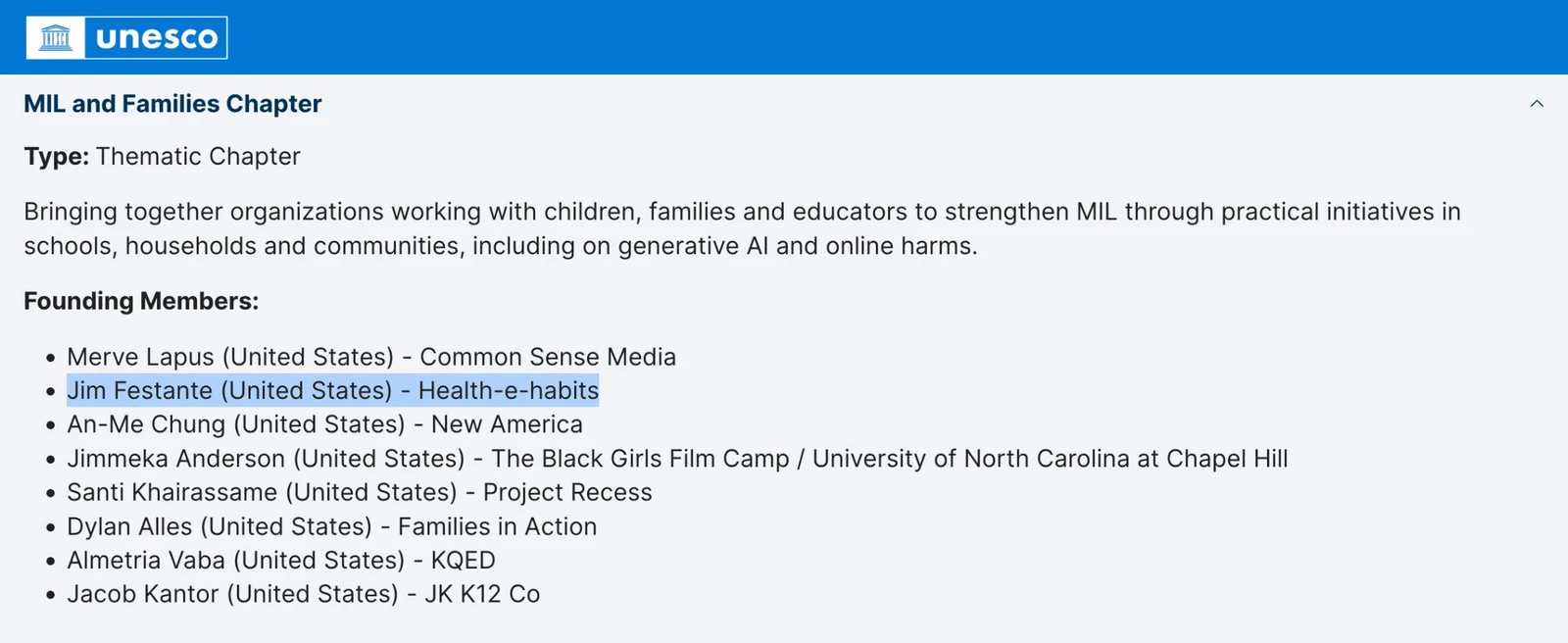
Last week, UNESCO’s Media and Information Literacy (MIL) Alliance announced 16 new Chapters: regional and thematic groups that bring its 700-plus members in 110 countries together around shared work. Health-e-Habits is a founding member of one of them, the MIL and Families Chapter.
Media and information literacy sounds like a mouthful. It’s the skill of knowing how the things on your screens work: who made it, how it makes money, how it decides what you see next, and whether it’s true. It’s what we teach, whether we’re in a school assembly, a parent workshop, or a report on the Video Game Minimap.
Most of that teaching happens in classrooms. But the phone, the console, and now the chatbot all come home at 3:30. Parents are on the front line, usually without a manual. The MIL and Families Chapter brings together organizations that work with children, families, and educators, and it’s focused on practical work in homes, schools, and communities, including generative AI and online harms.
We’re building it alongside some people we admire: Merve Lapus of Common Sense Media, An-Me Chung of New America, Jimmeka Anderson of The Black Girls Film Camp and UNC Chapel Hill, Santi Khairassame of Project Recess, Dylan Alles of Families in Action, Almetria Vaba of KQED, and Jacob Kantor of JK K12 Co.
As UNESCO’s Mariya Gabriel put it, media and information literacy “is a shared commitment that requires cooperation across borders, sectors and communities.” We’d add one more place it has to happen: the living room.
Here’s what we bring to the table: over 20 years inside the games and tech industry, the people who build what your kids use every day. That inside view shapes everything we make, from workshops for parents and programs for schools to the Video Game Minimap and Inside the Game.
We’ll share what the Chapter builds here as it happens. In the meantime, if you want something practical tonight, grab our free Roblox settings checklist, or sign up for the newsletter.
Same stance as always: we’re not here to take the screens away. We’re here to help families understand them. Don’t just restrict the screen. Decode it.